


What Is a Chronograph?
Although you will likely never use it for anything more complicated than your daily run or boiling an egg, chronograph watches are arguably the most popular complication offered by Swiss watchmakers.
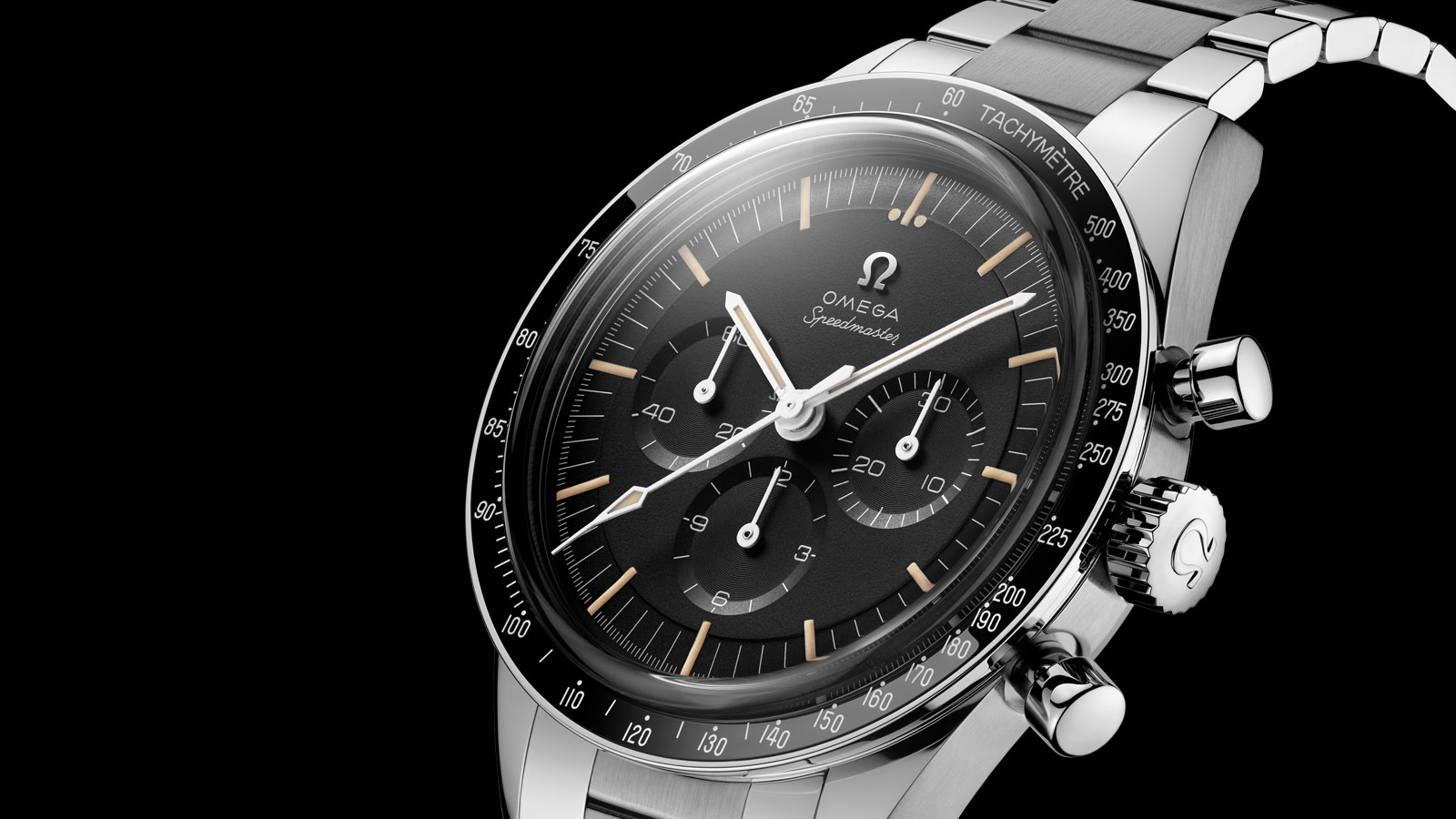
A chronograph is simple – it’s essentially a built-in stopwatch. Don’t confuse this with a chronometer. A chronograph will always have extra pushers, normally at 2 and 4 o’clock. A chronometer merely refers to the precision of the watch tested by an external agency so, confusingly, a chronograph can also be a chronometer.

How Does a Chronograph Watch Work?
The majority of chronograph watches feature two additional buttons (pushers) on either side of the crown:
- Start/Stop Button: Most commonly positioned at 2 o’clock – press to start/stop the timing process.
- Reset Button: Most commonly positioned at 4 o’clock – press to reset all the chronograph hands to zero once stopped.
Pressing start engages an internal gear train, and a central chronograph hand begins to sweep around the dial. Sub-dials (those little secondary circles on the watch face) are used to indicate minutes and hours of elapsed time. When you are finished timing, simply stop and reset the timer. You can even time multiple laps by stopping, reading the elapsed time, and immediately resetting and starting again.
Many chronographs also feature a tachymeter (speed calculator) – a scale on the bezel or outer dial that is used to calculate speed based on the amount of time elapsed over a fixed distance.
Just remember: if your chronograph runs on mechanical movement (not quartz or battery), frequent use can slightly shorten the movement’s power reserve. When that happens, an authorized watch repair service near you can help restore your watch to peak performance.

Types of Chronographs
Standard Chronographs
A standard chronograph allows you to measure elapsed time using a simple start, stop, and reset sequence. Most designs feature two pushers positioned at roughly 2 and 4 o’clock on the case. Pressing the top pusher starts the chronograph, engaging a central seconds hand, while sub-dials track elapsed minutes and hours. Pressing the same pusher again stops the timing, and the lower pusher resets all hands to zero.
This layout is the foundation of most chronograph watches and remains the most common format today. It offers reliable timing functionality without the added complexity of flyback or split-second mechanisms.
Modular vs Integrated Chronograph Movements
The most straightforward chronograph has a modular movement, which means an additional module has been placed on top of the main timekeeping mechanism, creating a mechanical sandwich, which is why chronographs are typically thicker. More sophisticated models tend to be slimmer, such as the legendary Zenith El Primero – billed as the world’s most precise automatic chronograph – with a stopwatch function integrated into the actual movement.
High-Frequency & Flyback Chronographs
For those taking timing even more seriously, a watch like the Zenith Stratos Flyback Striking 10th Automatic Chronograph, has a “flying” central hand which goes around the dial each second. It is used to measure time, in increments of 1/10th of a second. Unlike a standard chronograph you can measure time increments more precisely like this.
Split-Second (Rattrapante) Chronographs
To time events simultaneously, such as a two-person race, a split-second chronograph is the one for you. In this type of chronograph there are, in fact, two seconds hands, invisibly stacked one on top of the other. Activate a third pusher, often on the other side of the case, and the top hand will stop, recording the time of the first person, while the hand underneath will carry on tracking the second person’s progress. Closer to home, for a couple who have different boiled egg preferences, it’s the difference between runny and firm.
Slide Rule Chronographs
Chronographs get seriously geeky when circular slide rules are printed onto the bezel or inside the outer rim of the dial. Bankers can use them to convert dollars to yen and car enthusiasts to time the average speed of a car – providing their eyesight is sharp enough to read the tiny numbers.
A Brief History of the Chronograph
Many famous watch brands, including TAG Heuer and Omega, made their name over the course of the last century as makers of precision stopwatches, starting with the invention of the first chronograph in 1816 by Lois Moinet. A later version developed by Nicolas Mathieu Rieussec in 1820 to time horse races included discs onto which a drop of ink marked the time elapsed . The term was particularly well chosen: chronograph comes from the Greek words chronos and graphin, which means “that which writes time”.
What Are Chronographs Used For Today?
Chronographs were originally practical instruments. Pilots used them to navigate, racers timed laps with them, and divers used them to time how long they had been underwater. A chronograph can still be used for all those purposes today, but people also like to wear them because they look cool. It’s like a smartwatch’s timer function, but much more elegant.
Popular Chronograph Watches (examples)
Tudor Black Bay Chronograph 41mm 79350
The Tudor Black Bay Chronograph 79350 is a sporty-vintage watch that delivers perfect performance. With a 41mm stainless steel case and bold black dial, this watch strikes a confident style without appearing too large. And the two sub-dials are classic chrono lines.
It has an automatic movement for accurate, dependable performance, a sapphire crystal for scratch-resistance, and a beautifully balanced dial. This is the best of traditional Tudor tool watches with a modern touch of reliability.

Omega Speedmaster 57 Automatic Chronograph 331.20.42.51.02.001
One of the most legendary chronographs is undoubtedly Omega’s Speedmaster ‘57 331.20.42.51.02.001. In this two-tone stainless steel and 18K yellow gold version, the Speedmaster takes the form of a large, striking silver dial paired with an equally emphatic tachymeter bezel.
The watch measures 41.5mm in diameter, which provides sporty toughness, but its refined construction prevents it from becoming overly harsh. Driven by Omega’s own Co-Axial Calibre 9300 automatic movement, it’s a wonderfully crafted sports chronograph with a luxurious shine.

IWC Portugieser Yacht Club Chronograph Edition “Orlebar Brown” IW390704
This one is for nautical luxury aficionados. The IWC Portugieser Yacht Club Chronograph Edition “Orlebar Brown” (IW390704) is a sporty, elegant watch. It has a 44.6mm stainless steel case and a blue dial with contrasting accents.
This chronograph has been designed for sailing: it features a flyback mechanism that allows you to reset and restart a timing interval with the push of a single button. The Yacht Club Chronograph comes with a blue rubber strap with textile inlay for comfort and a contemporary look. It’s powered by an in-house automatic movement with a 68-hour power reserve.
Hublot Big Bang Chronograph 18K Rose Gold 301.PB.131.RX
Bold, modern, and undeniably luxurious, the Hublot Big Bang Chronograph 301.PB.131.RX is a watch that doesn’t whisper; it announces.
The 18K rose gold case, which comes in a substantial 44mm size, is accompanied by a black dial with rose gold accents for a high-contrast and high-impact look. Chronograph functions are tracked by multiple sub-dials, and the pushers and crown add to the Big Bang’s signature industrial design language.

Iconic Chronograph Watches
Over the decades, several chronograph watches have become benchmarks for the complication itself. Models such as the Rolex Daytona, TAG Heuer Carrera, Zenith El Primero, and Breitling Chrono-matic remain enduring references, valued for their performance, design, and historical relevance. Their layouts still reflect the precision instruments that originally inspired chronograph development.
One of the chronograph’s most famous real-world moments came during NASA’s Apollo missions. Mechanical chronographs—most notably the Omega Speedmaster—were relied upon by astronauts during critical mission phases. During the Apollo 13 crisis in 1970, a Speedmaster chronograph was used to help time essential engine burns when onboard systems failed, reinforcing the chronograph’s reputation as a dependable mechanical tool even in extreme conditions.
Is a Chronograph Watch Worth It?
Definitely, especially if you appreciate functionality and design. Chronographs also complicate the visual perception of a watch, which is rarely a bad thing. The chronograph complication has been a perennial favorite with watch enthusiasts and collectors, as well as professional users and fashion aficionados.
Of course, they will cost more. But for many enthusiasts, that’s part of the appeal. You’re paying for complexity, and, depending on the brand, craftsmanship, and history.
Iconic Chronograph Watches
FAQs
What is the purpose of a chronograph watch?
A chronograph is a watch that allows you to measure elapsed time. It does so with the help of built-in start-stop-reset functions. In other words, it’s a stopwatch and a watch in one.
Chronograph vs Chronomat: What’s the Difference?
Is a chronograph the same thing as a Chronomat? No. A chronograph is a watch function that allows you to measure elapsed time using a stopwatch-style mechanism. Chronomat, on the other hand, is the name of a specific watch collection made by Breitling. While many Chronomat models include a chronograph function, the term itself refers to the model line, not the complication.
Is a chronograph better than an automatic?
A chronograph and an automatic describe two different aspects of watches. Chronograph refers to the function (the stopwatch feature), while automatic refers to the type of movement used (a movement that’s self-winding, rather than battery-powered). A watch can be both, but they don’t inherently have to be.
Do chronograph watches need a battery?
Some do (quartz chronographs), but many do not. Many higher-end watches have automatic mechanical movements and thus do not need batteries.
Can a chronograph be an everyday watch?
Absolutely! In fact, many chronographs are intended for daily use.


