


The Olympic Games Have Begun — and Omega Is Timing Every Second
The Olympics have kicked off, and Omega will be there for every second. Established as the official timekeeper of the Olympics, the brand has a strong presence at each event. As the official Olympic timekeeper, Omega has built its reputation on precision and reliability, values that extend well beyond the Games and into its broader watch collections.

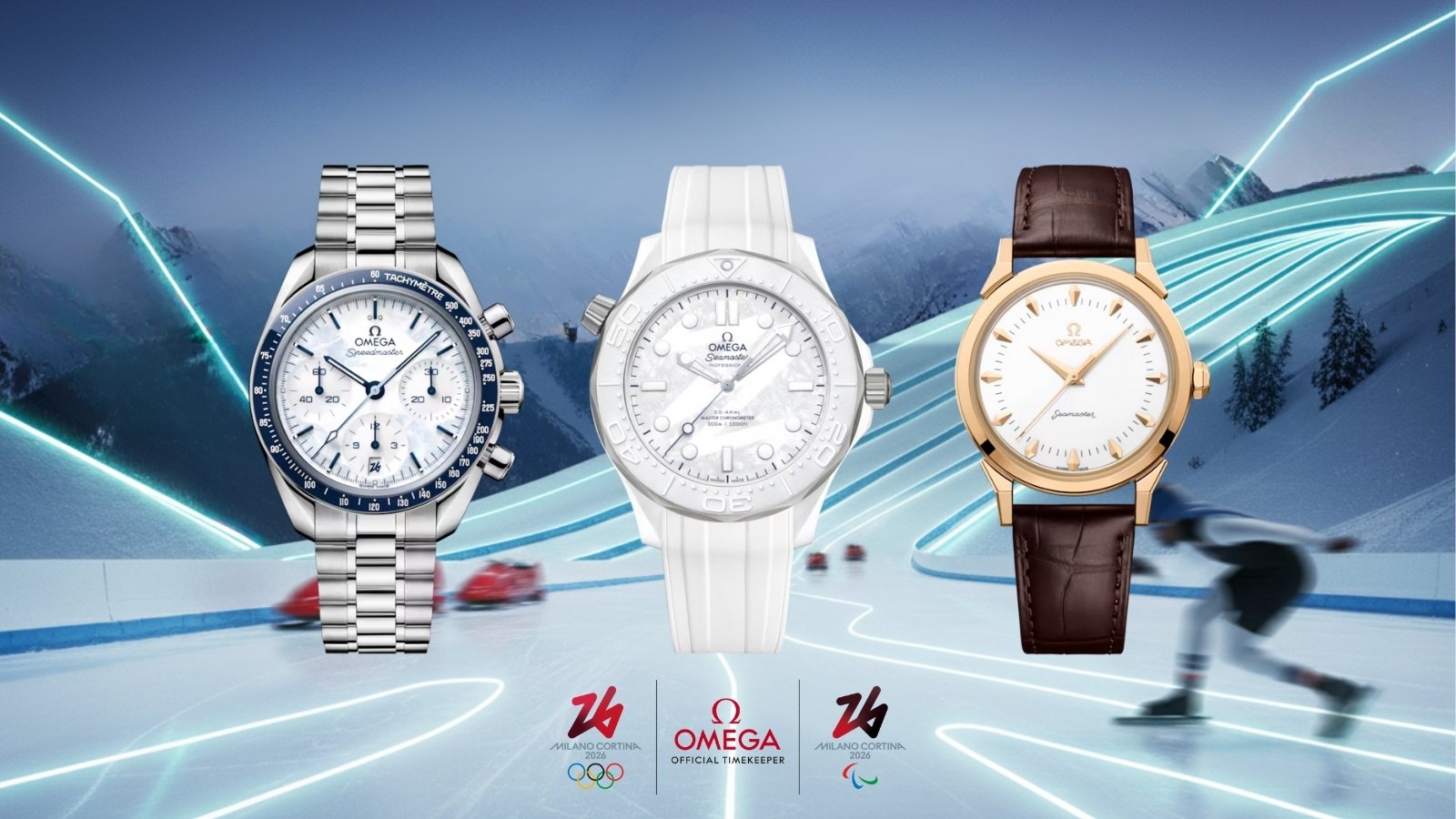
This year, Omega will be timing events at the 2026 Olympics in Milan-Cortina, Italy, which runs from February 6-22, marking their 32nd Olympic appearance. They will use equipment that meets the specifications of each category and their requirements. The brand also released three watch models to honor their commitment.

The History of Omega and the Olympics
Do you know that Omega didn’t start out as a watch brand? Rather, it was a movement developed in Louis Brandt’s Swiss workshop in 1894 and later used in his timepieces. It earned chronometer prizes for its precision, building a reputation that led the Brandt company to adopt the Omega name.

The Olympics recognized the high precision of Omega timepieces and appointed the brand as its timekeeper in 1932. Since then, a single Omega watchmaker travels to the games with 30 high-precision chronographs to stop-time events. With one company timing all events, the process is professional and standardized.

Omega’s Milano Cortina 2026 Watches
It is not unusual for Omega to release watches that honor Olympic events. This year, they introduced three models to the Omega Olympic collection, including the following:
Diver 300M Milano Cortina
The Diver 300M Milano Cortina features white ceramic and titanium, producing an icy look that perfectly captures the aesthetic of the 2026 Olympics. While it is a larger watch at 43.5mm, the materials keep it light, making it easy to wear for competitions and every day. The dial is laser-engraved with a frosted fingerprint pattern inspired by the Cortina 2026 emblem, enhancing the wintry appearance.
You can explore the full specifications in our Omega Diver 300M Milano Cortina Review.

Functionally, its high water resistance and diving scale make it a robust diver’s instrument. The co-axial master chronometer Calibre 8806 automatic movement is METAS-certified, the Swiss industry’s highest-accuracy standard. It operates at 25,200 VpH and features a silicon balance spring, bidirectional winding, and luxury finishing with a rhodium-plated rotor.

Speedmaster 38 Milano Cortina
The Speedmaster 38 Milano Cortina was released just 100 days before this year’s Olympics. Compact and sportier than previous Speedmaster 38 models, it features a blue ceramic bezel and a white, frosted dial, offering a wintery aesthetic. It also stands out for its vintage-inspired, more masculine design, which veers away from the traditional oval sub-counters and bi-material bezels.
You can explore the full specifications in our Speedmaster 38 Milano Cortina 2026 review.
As an Olympic watch, it uses the reliable chronometer-grade Calibre 3330 family architecture found in other Speedmaster 38s. Its subdials are ideal for timing purposes. It also features a tachymeter bezel that measures the average speed over a known distance, with a scale that’s extremely scratch and fade-resistant.
Seamaster 37mm Milano Cortina
The Omega Seamaster 37mm Milano Cortina is a dressy, vintage-inspired recreation of the original 1957 Seamaster 2850. Although an Olympic tribute, it is elegantly proportioned, emphasizing subtle refinement over sporty functionality. Key features include a polished 18K gold finish, a white Grand Feu enamel dial, and the 2026 Milano Cortina Olympic emblem engraved in the caseback.

While the watch is more celebratory than athletic, it offers robust functionality that one would expect from an Omega. Its 100m water resistance is significant, exceeding that of most dress watches. The timepiece also comes with a METAS chronometer certification, meaning it was COSC tested to the highest accuracy standards.
These movements are tested to strict accuracy standards, earning chronometer certification. If you’re curious about what that actually means in day-to-day use, our guide on chronometer certification explains how these tests work and why they matter.

Celebrate the Olympics with a New Precision Watch Timepiece
Omega’s Olympic role highlights the importance of reliability and consistency at the highest level of competition. That same philosophy carries through many of the brand’s everyday timepieces, where accuracy and durability remain central.
For those interested in learning more about high-precision watches or exploring similar models, Precision Watches offers guidance both online and in person at our Lower Gwynedd location.
FAQs
Are the Milano Cortina Omega watches limited edition?
No, none of the Milano Cortina Omega watches are advertised as limited edition. The Speedmaster 38 is advertised as a special edition, but no limited quantity is specified. However, it is likely that the watches will phase out after the games, increasing their potential as collectors’ items.
What timing technologies has Omega introduced at the Olympics over the years?
Omega has introduced various timing technologies at the Olympics over the years. Here are some of note:
- 1932: Omega’s high-precision chronograph stopwatches established the brand as the first company to time the entire Olympics to 1/10 of a second. In subsequent years, this would increase to 1/1000 of a second.
- 1948: The Magic Eye was the first photo-finish camera to record image and time simultaneously
- 1964: Omega’s Cope became the first real-time TV overlay of stopwatch results on screen
- 1968: Swimming touchpads allowed athletes to stop their own times by touching the pool wall
- 1988: Computerized timekeeping and a video matrix board provided digital storage, color video displays, and real-time data
Are the Milano watches suited to everyday wear?
The Seamaster Diver and Speedmaster 38 are both ideal for everyday wear. The Dive may be the best choice because it is highly water- and scratch-resistant and features exceptional anti-magnetism. The Speedmaster is also a good choice for its wearable size and combination of sporty and smart features. The Seamaster is also robust, but its dressy look may make it more suitable for office or formal wear.
Are Omega Olympic watches good long-term collectibles?
The year’s Omega Olympic watches could be good long-term collectibles as they are associated with a specific event. However, there is no guarantee of value or demand. Olympic watches that have gained value in the past include:
- Rio 2016 editions, which were sought after for their unique designs and low production
- Speedmaster 3513.20.00 (2004 Athens), which is prized for its rarity and Olympic association
- Seamster Diver 300M (Beijing 2008), a limited-edition release.


