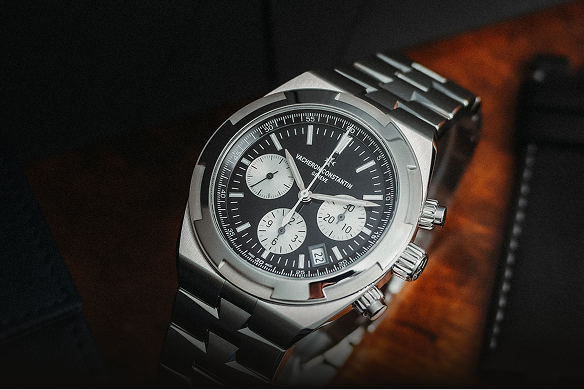
Annual Calendar
Let’s start with the most important and obvious difference between an annual calendar and perpetual calendar. A watch with an annual calendar must be manually set once a year, while the perpetual calendar does not. The annual calendar is automatically adjusted following every month with 30 or 31 days. However, it must be manually set every 1st day of March because the annual calendar does not recognize that February only has 28 days, or 29 days for leap years. As a result, the annual calendar must be manually set once a year, while the perpetual calendar does not have to be reset. With a combination of difference levers and movements, the perpetual calendar will automatically change to the correct date, including from February 28th or 29 th to March 1st. A great example of an annual calendar watch is the Omega Constellation Globemaster 130.33.41.22.02.001, which features Omega’s signature precision and craftsmanship while requiring adjustment only once per year.

Perpetual Calendar
Perpetual Calendars do not need to be adjusted until 2100. The reason it must be adjusted in this year is because, usually, years that are divisible by 4 are leap years. However, years that end in 00 must be divisible by 400 to be a leap year. The perpetual calendar does not take this last part into account, so the watch must be adjusted at year 2100. IWC has just recently developed a perpetual watch movement that will not have to be updated until 2499. However, if you ever are setting the date on your perpetual calendar, make sure you do it correctly. If you accidentally set it on the wrong date, you have to wait until the battery runs out before you can fix it.
Since the 1920s, watch companies have been creating watches with perpetual calendars, Patek Philippe being the first. In 1985, IWC created the most advanced perpetual calendar with its release of the IWC Da Vinci. Patek Philippe patented the first annual wristwatch in 1996.

Obviously, a watch with a perpetual calendar is much more complicated than a watch with an annual calendar. As a result, perpetual calendars are significantly more expensive than an annual calendar.
One of the most sought after Pre-Owned Rolex watches, if you are looking to buy or sell your pre-owned Rolex, is the custom 16238 Perpetual Calendar sitting on a stunning President’s bracelet with bark finish, that was modified by the master of watch complications, Franck Muller. The Pre-Owned Rolex Unicorn myth goes: roughly in 1987, Muller was about to break out on his own. He took a perfectly functional yellow gold Pre-Owned Rolex Datejust 16238 with the 3135 movement and brought to life, as the Perpetual Calendar.