Few brands made a stronger case for shaped watch design at Watches and Wonders 2026 than Cartier. The lineup of Cartier watches included the returning Roadster, a new mainline Tortue collection, a tenth-anniversary Cartier Privé trilogy, bracelet-equipped Santos-Dumont models, a reworked Baignoire, and the new Myst de Cartier. What made the year stand out was not one single watch, but the breadth of Cartier’s design language across sportier cases, classic forms, and jewelry-led pieces.
The Lineup Extended Well Beyond Privé
Cartier Privé remains one of the Maison’s most closely watched annual releases, and the tenth-opus format gave the 2026 edition added weight. But the broader Cartier story went beyond Privé. Cartier also brought back the Roadster, expanded the Tortue into a wider mainline collection, rethought the Santos-Dumont through a bracelet-first update, and pushed further into jewelry watchmaking with the Baignoire and Myst. That gave the 2026 lineup a wider shape than a single archival spotlight.
That broader view also fits Cartier’s longer design history. The Maison’s watches have evolved across very different forms over time, which helps place this year’s releases inside a much longer tradition of shape-led design.
The Roadster Was the Major Return
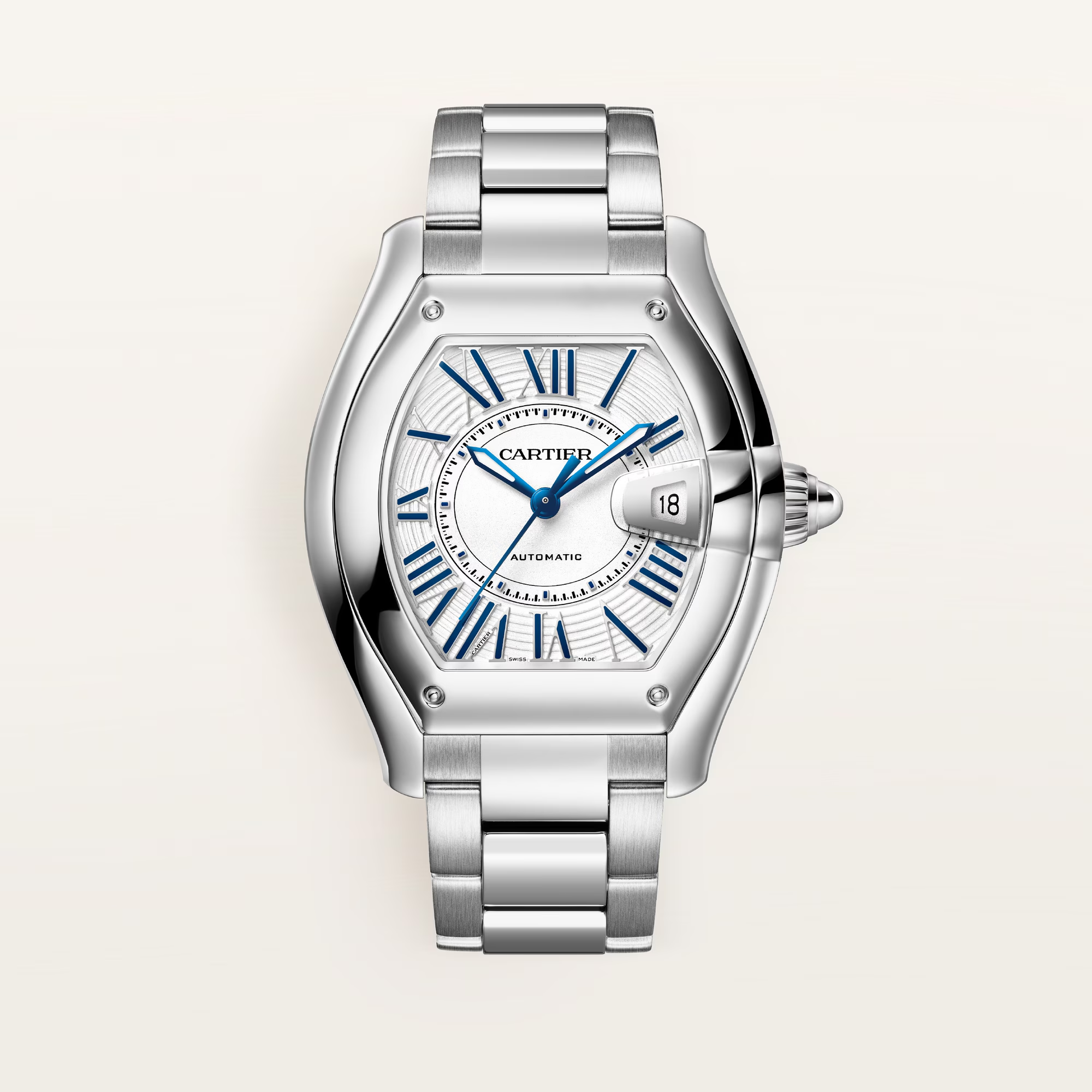
The Roadster’s return was one of the clearest statements in Cartier’s 2026 lineup. First introduced in the early 2000s, the Roadster came back in medium and large sizes, with steel, steel-and-gold, and gold versions, plus a blue-dial large steel model on a rubber bracelet. Its core design cues remain intact: the shaped case, integrated stylized crown, and magnified date treatment built into the crystal. Depending on size, the watch is powered by Cartier’s 1847 MC or 1899 MC automatic movement.
The case is more curved than the Santos, the dial language is more overtly automotive, and the overall profile has a softer, more flowing shape. In a year filled with shaped dress watches and jewelry pieces, the Roadster added another tone to the catalog without feeling out of place.

The Tortue Returned as a Complete Collection
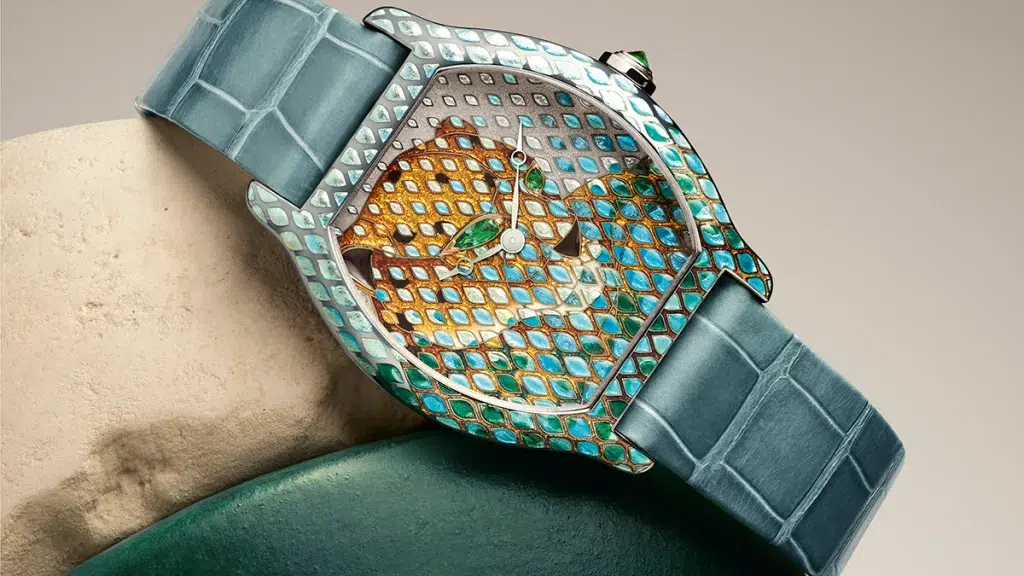
The Tortue was one of the most substantial parts of Cartier’s 2026 release slate. After the 2024 Privé edition, Cartier brought the Tortue back as a broader collection rather than a single commemorative watch. The new line includes mini and small precious-metal references, a more formal diamond-set platinum evening version, and two Panthère Métiers d’Art models limited to 100 pieces each.

The case appears slightly rounder and softer than earlier Tortue versions, while keeping the watch’s shaped identity central to the design. Sizes range from 20.9 mm to 34.8 mm, and the models use Cartier’s in-house 430 MC.
Cartier Privé Marked Its Tenth Opus
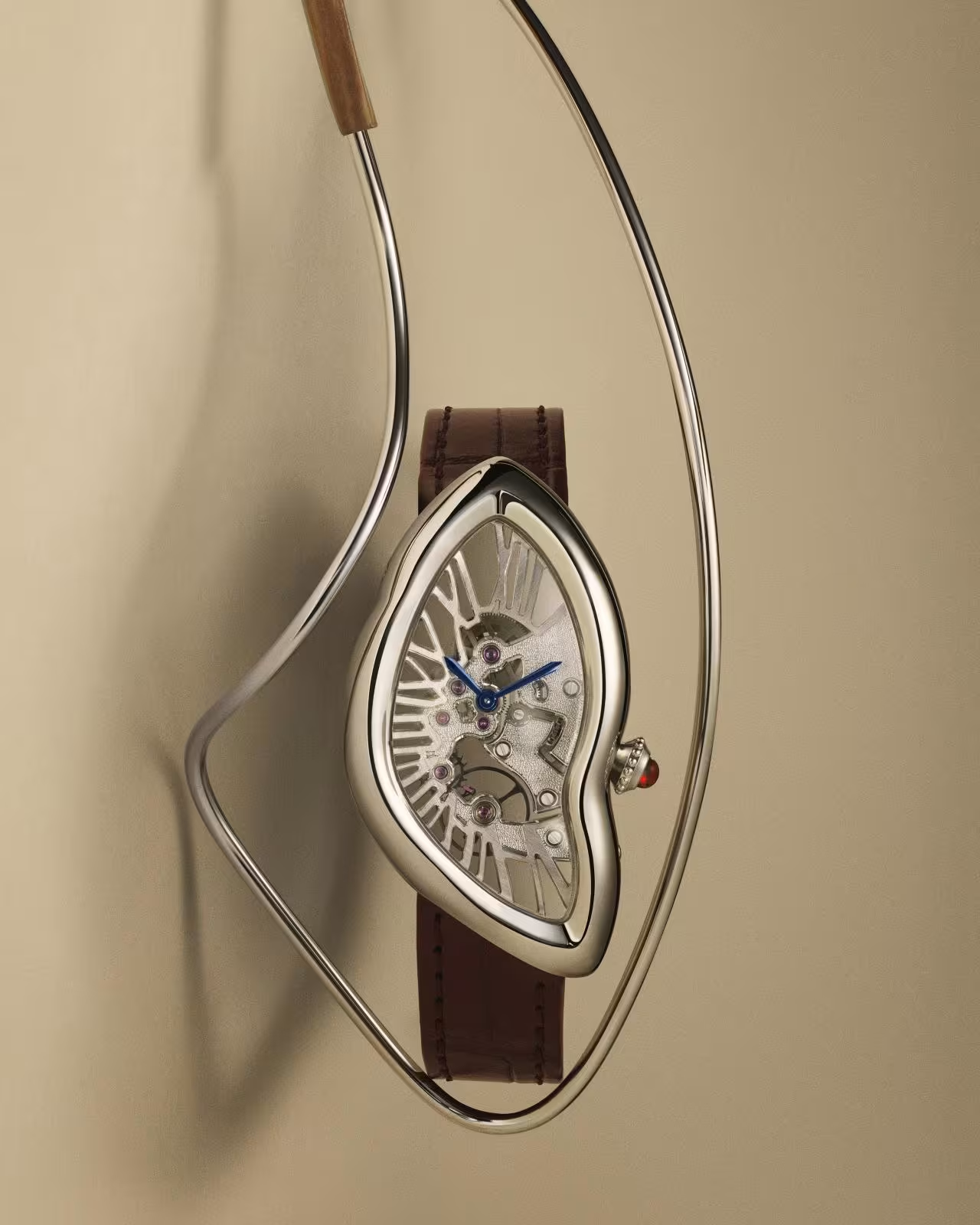
For its tenth Privé edition, Cartier split the release into two trios. The platinum “Trio Exceptional” brought together the Tank Normale, Tortue Chronograph Monopusher, and Crash Skeleton in platinum with burgundy accents, ruby cabochons, and new movement work in the Tortue and Crash. The Crash Skeleton introduced the hand-finished 1967 MC movement inside the asymmetric case and was limited to 150 pieces. Alongside that came Privé La Collection in yellow gold, including the Tank Normale, Cloche de Cartier, and Tank Cintrée with golden dials, apple-shaped hands, and gray alligator straps.
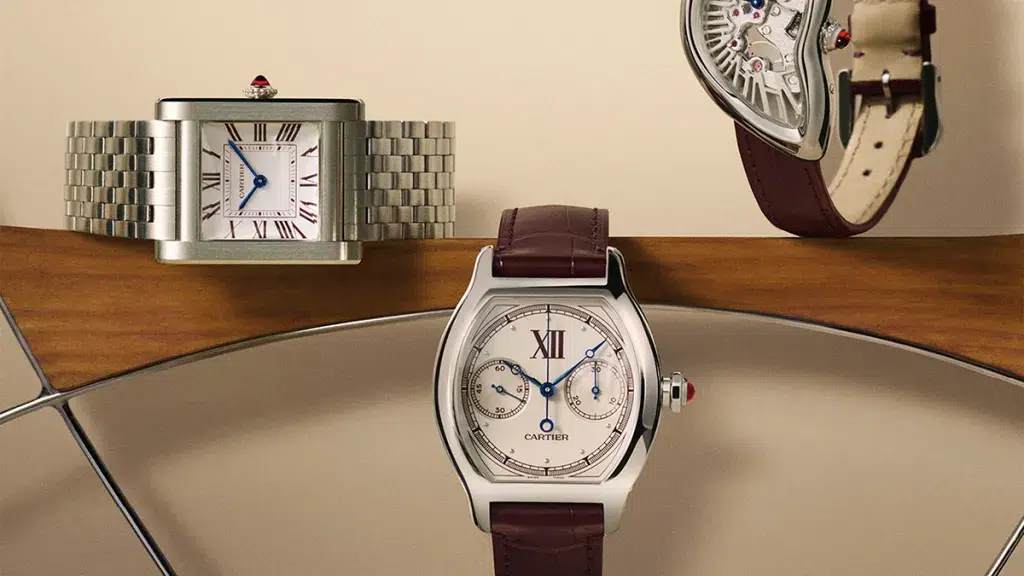
What stands out here is not only the choice of models, but the way Cartier used Privé to revisit several different sides of its design history at once. The Tank Normale brings back one of the Maison’s foundational forms. The Tortue Monopusher adds mechanical emphasis. The Crash Skeleton pushes asymmetry into a more technical direction. The yellow-gold trio then shifts the mood again, with a softer and more classical treatment.
The Santos-Dumont Bracelet Was a Precise Update
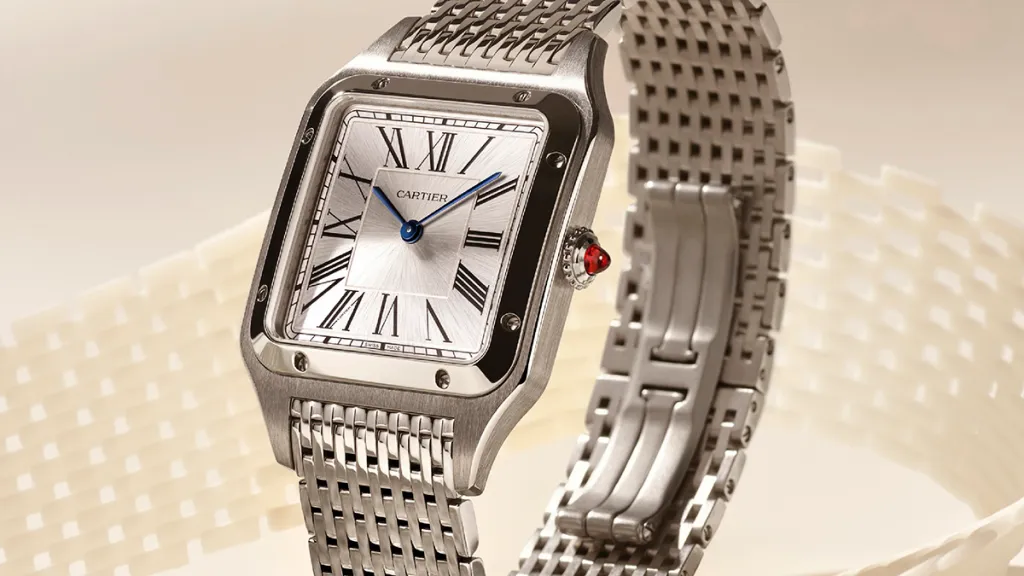
Cartier kept the familiar manually wound 430 MC and the recognizable square case of the Santos-Dumont, but introduced an exceptionally fine bracelet made of 394 links across 15 rows and only 1.15 mm thick. The new bracelet versions came in yellow gold and platinum, including a yellow-gold model with a gilded obsidian dial. The bracelet’s flexibility and jewelry-like fluidity are central to the design.
The bracelet shifts the way the watch sits and moves on the wrist, which is why it feels like a meaningful update rather than a simple alternative strap configuration. Readers who already know the model through the Cartier Santos-Dumont review will immediately recognize why bracelet design changes the tone of the watch so much. For readers interested in current square-case Cartier models, the Santos de Cartier collection offers a broader look at the line.
The Baignoire and Myst Extended Cartier’s Jewelry Watchmaking
Cartier’s 2026 lineup also made room for pieces that sat closer to jewelry than to conventional watch categories. The Baignoire was reworked through the Clous de Paris motif, applied across the case, dial, and bracelet in yellow gold, with one version fully set with diamonds. Readers interested in the design can also explore our Cartier Baignoire review or browse the current Cartier Baignoire collection.

The Myst de Cartier went further into sculptural territory, using a clasp-less bracelet concept with either yellow gold, black lacquer, and onyx, or a heavily diamond-set white-gold version.
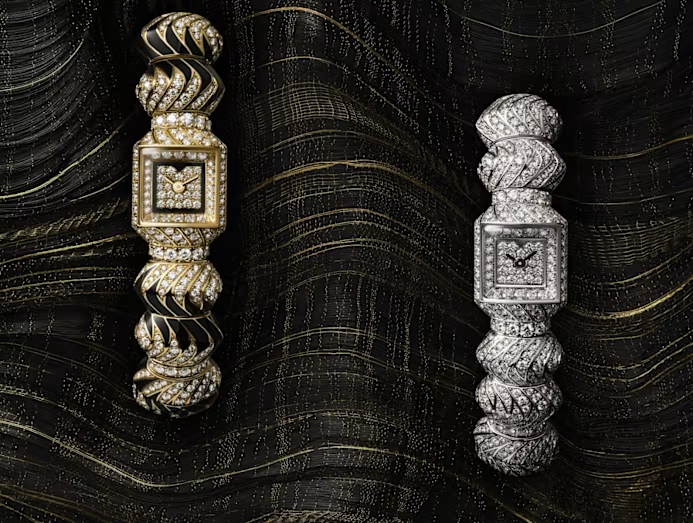
These watches underline something Cartier does particularly well; it can move between watchmaking and jewelry without breaking the visual logic of either. That same balance is part of what has made the Cartier Panthère watch such an enduring part of the Maison’s women’s watchmaking story.
What Cartier’s 2026 Releases Showed
Cartier’s Watches and Wonders 2026 releases showed a Maison comfortable working across several different kinds of watch design at once. It brought back the Roadster, expanded the Tortue, marked a milestone year for Privé, refined the Santos-Dumont through bracelet work, and continued to develop jewelry watchmaking through the Baignoire and Myst. The lineup was broad, but it remained coherent because Cartier’s approach to shape and proportion shone.
Cartier at Precision Watches Near Philadelphia
For readers following Cartier beyond the fair itself, Precision Watches is a useful place to continue the conversation. Located just outside Philadelphia in Lower Gwynedd, Precision Watches offers new Cartier watches and Cartier watch repair and service.

Frequently Asked Questions About Cartier’s Watches and Wonders 2026 Releases
What new Cartier watches were released at Watches and Wonders 2026?
Cartier’s 2026 lineup included the returning Roadster, a new mainline Tortue collection, the Cartier Privé tenth-opus trilogy and yellow-gold La Collection trio, new Santos-Dumont bracelet models, the Clous de Paris Baignoire, and the Myst de Cartier.
Is the Cartier Roadster back in 2026?
Yes. Cartier brought back the Roadster in medium and large sizes, with steel, steel-and-gold, and gold versions, plus a blue-dial large steel model on rubber.
Why did the Tortue matter in Cartier’s 2026 lineup?
Because Cartier treated it as a broader collection rather than a single return. The 2026 Tortue lineup included everyday precious-metal pieces, a more formal evening version, and limited Panthère Métiers d’Art models.
What changed on the Cartier Santos-Dumont in 2026?
The key update was a new ultra-thin bracelet made of 394 links across 15 rows, offered on yellow-gold and platinum models, including one yellow-gold version with a gilded obsidian dial.
Did Cartier release new jewelry watches in 2026?
Yes. The Baignoire received a Clous de Paris treatment across the case, dial, and bracelet, and the Myst de Cartier introduced a more sculptural, gem-set concept with bracelet-based architecture.