


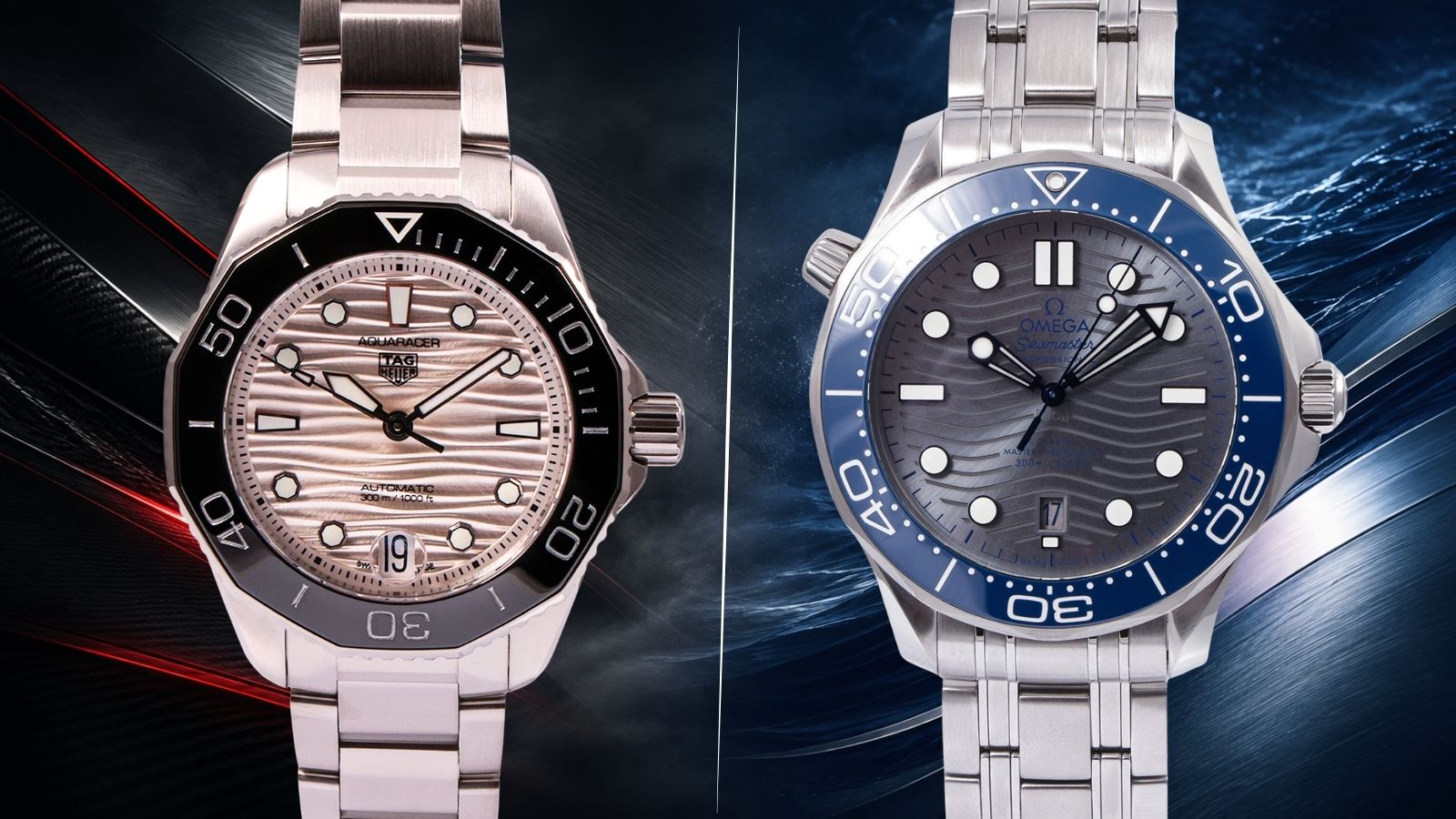
Ask someone shopping their first serious Swiss watch which brands they are weighing, and TAG Heuer and Omega come up together constantly. Both are storied names. Both make sports watches with real history. Yet they occupy different tiers, and the differences matter once you look past the badge. This comparison lays them out by the factors that actually decide a purchase.
Price and Positioning
Price is the clearest divide. TAG Heuer’s sweet spot runs from roughly $2,000 to $4,000, where you get a Swiss automatic in a well-finished case. Its range starts lower still, with quartz models beginning around $1,500. Omega’s core lineup, the Omega Speedmaster Moonwatch, Seamaster 300M, and Aqua Terra, generally falls in the $5,000 to $8,000 range, and climbs well past that for precious metals and limited editions.
Because of this, the two brands often serve buyers at different moments. TAG Heuer is frequently a first Swiss luxury watch. Omega is frequently the step up from there. That is positioning, not quality, and it shapes everything else in the comparison.
Movements
This is where Omega has pulled ahead most clearly. Every current Omega mechanical watch uses an in-house co-axial movement with METAS Master Chronometer certification. The co-axial escapement reduces friction, which supports longer service intervals, and METAS certification tests each watch for accuracy and magnetic resistance well beyond older standards.

TAG Heuer takes a mixed approach. Many of its best-known non-chronograph models, including much of the Aquaracer and Carrera range, run the Calibre 5, which is built on ETA or Sellita bases. These are proven, reliable, and easy to service anywhere. TAG Heuer also produces in-house calibers, such as the Heuer 02 chronograph movement, at the higher end of its range. As a result, a TAG Heuer buyer chooses between accessible workhorse movements and pricier in-house options, while an Omega buyer gets in-house technology across the board.

Design and Identity
The two brands pull from different histories. Omega’s identity is built on space and the sea: the Speedmaster went to the Moon in 1969, and the Seamaster has been a definitive dive watch since 1948, later cemented by its association with James Bond. Consequently, Omega designs tend toward classic, restrained sports-watch forms.

TAG Heuer’s identity is motorsport. The Tag Heuer Carrera, introduced in 1963, was named for a road race, and the square-cased Monaco became an icon on Steve McQueen’s wrist. TAG Heuer designs are generally sportier and more overtly modern. Neither approach is better. A buyer drawn to racing heritage and bolder styling leans TAG Heuer, while one drawn to tool-watch classicism leans Omega.

The Flagship Matchup | Aquaracer vs Seamaster
The most common head-to-head is the TAG Heuer Aquaracer against the Omega Seamaster, since both are steel sports divers in overlapping sizes. The Aquaracer typically offers higher water resistance at a given price and, in some references, a lighter titanium case. The Seamaster counters with the in-house co-axial movement, METAS certification, and a heavier, more substantial feel on the wrist.
The price gap is real and consistent. New, the Seamaster Diver 300M lists around $1,200 above a comparable Aquaracer. Pre-owned, the spread often widens, with a used Seamaster commanding meaningfully more than a used Aquaracer. That gap is the comparison in miniature: you pay more for the Omega, and you get more movement technology and stronger resale for it.
Value Retention
Omega holds value better, and the market is clear on why. Its watches carry stronger brand recognition at the luxury tier, in-house movements, and steady collector demand. For owners weighing a sale, our guide to Omega resale value covers what drives those figures. TAG Heuer watches, particularly ETA-based models, tend to depreciate more from retail.
For a buyer, that cuts two ways. If resale matters, Omega is the safer store of value. If you want the most watch for the least money up front and plan to keep it, TAG Heuer’s depreciation becomes an opportunity on the pre-owned market. Our deeper look at TAG Heuer resale value breaks down which models perform best. This is also why buying a pre-owned Omega can be one of the smartest ways into the brand.
Which Should You Choose?
Choose Omega if movement technology and value retention lead your priorities, if you want METAS-certified in-house calibers, or if the space-and-sea design language appeals. Expect to spend more to get in.
Choose TAG Heuer if you want genuine Swiss heritage and sporty, motorsport-driven design at a lower entry point, if a proven ETA or Sellita-based movement suits you, or if you are buying your first Swiss luxury watch and want room to grow.
At Precision Watches, we can help either way. As an Authorized Omega watch dealer, we carry the current lineup and can walk you through the collections in person. We also buy, sell, and trade pre-owned TAG Heuer, so you can explore both sides without pressure. Visit our family-owned luxury watch store in Lower Gwynedd, or browse our new Omega watches and used TAG Heuer watches online.

TAG Heuer vs Omega FAQs
Is Omega better than TAG Heuer?
Neither is simply better. Omega sits at a higher price tier with in-house co-axial movements and stronger resale. TAG Heuer is more accessible and motorsport-driven. The right choice depends on budget, movement priorities, and design taste.
Which brand holds value better?
Omega holds value better on the secondary market, thanks to in-house movements and stronger luxury-tier recognition. TAG Heuer generally depreciates more from retail, which can make its pre-owned watches a strong value.
Are TAG Heuer movements in-house?
Some are. Many popular TAG Heuer models use the Calibre 5, built on ETA or Sellita bases. Higher-end pieces like the Heuer 02 chronograph use in-house calibers. Omega, by contrast, uses in-house co-axial movements across its mechanical range.
Is the Aquaracer or the Seamaster the better dive watch?
Both are capable. The Aquaracer often offers higher water resistance and a lighter case at a lower price. The Seamaster brings an in-house METAS-certified movement and stronger resale. The Seamaster costs more and holds value better.
Which is a better first luxury watch?
TAG Heuer is a common entry point at a lower price, while Omega is often the step up. If budget allows and resale matters, a pre-owned Omega is a strong first watch. If you want Swiss heritage at a lower cost, TAG Heuer fits well.


