


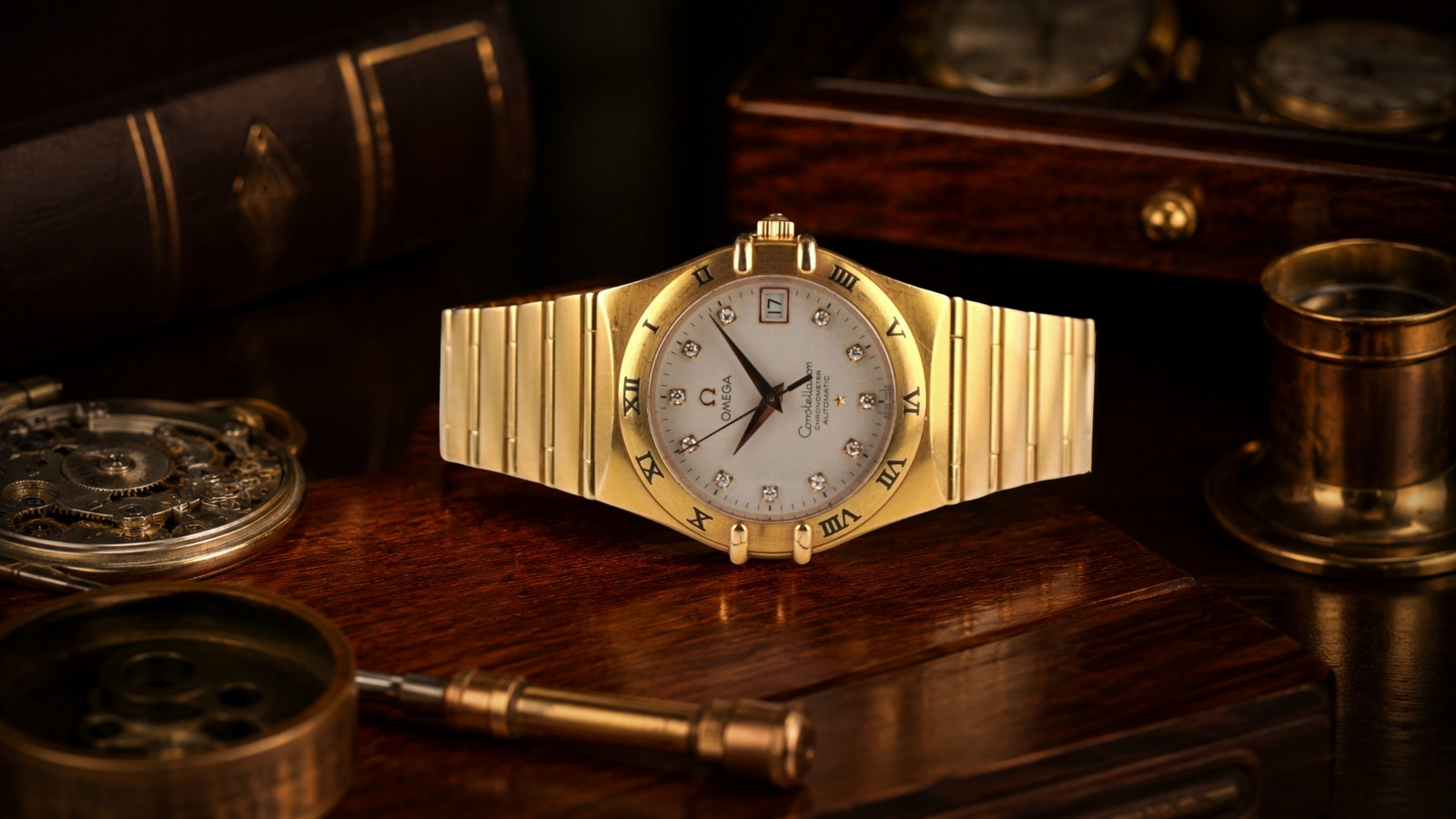
Vintage watches are often smaller than modern watches. Some collectors love them that way. Others struggle to see the appeal of anything under 40mm. However, the smaller proportions of vintage timepieces deliver a wearing experience that modern oversized watches simply cannot replicate.
This guide explains why vintage watches were made smaller, how that sizing affects daily wear, and why so many collectors are returning to vintage proportions today. For collectors specifically interested in smaller modern references, our guide to small watches for women covers contemporary options that capture the vintage spirit.

How Vintage Sizes Compare to Modern Watches
Vintage watches typically range from 34mm to 38mm in case diameter. By comparison, modern watches commonly sit between 40mm and 44mm, with some sport references pushing past 45mm. As a result, the typical vintage piece wears noticeably differently from a modern equivalent.
The shift toward larger cases happened gradually over the past two decades. Meanwhile, this trend created a collector base looking for bolder, more visible wrist presence. However, the same trend also created an opportunity for collectors who prefer subtlety. As large cases became the standard, vintage references gained renewed appeal among buyers who appreciate restraint.
For specific examples, mid-century references like the vintage Omega Constellation, Tudor Submariner 7928 (39mm), Longines Conquest 9000 series (35mm), and Cartier Tank Louis (24mm) all reflect this smaller sizing approach.

Why Vintage Watches Were Made Smaller
There was a time when restraint defined watch design. However, the smaller cases of vintage watches were not always a stylistic choice. Several practical reasons drove the design language of the mid-20th century.
Movement Size Limitations
Vintage movements were limited in size by the technology available at the time. Watchmakers could not produce movements in large calibers, so cases had to be designed to house the smaller mechanics. Hand-wound calibers also dominated the era, with automatic movements still in development.
As a result, watch cases reflected the constraints of the movements they contained. Once technology evolved and automatic movements with larger rotors became standard, cases expanded accordingly. Meanwhile, the engineering of thin manual-wind calibers from the 1940s through 1960s actually represented some of the finest precision watchmaking ever achieved.
Material and Machining Constraints
Modern watches benefit from advanced steel alloys, titanium, ceramic, and carbon composites. By contrast, mid-century watchmakers worked with limited material options and less sophisticated machining processes. As a result, smaller cases were easier to manufacture with the precision required for reliable function.
Today’s CNC machining and advanced material science allow watchmakers to push case dimensions further without sacrificing durability. Vintage watches, however, achieved their elegance precisely because of the constraints rather than in spite of them.
Dress-Watch-Centric Styling
Watches in the mid-20th century were primarily designed to be dress accessories. They were meant to slip discreetly under a shirt cuff and complement formal attire. A large wristwatch that protruded from a sleeve would have been considered unstylish in the 1940s, 1950s, and early 1960s.
As a result, watchmakers designed smaller, thinner cases that disappeared under cuffs while remaining elegant when visible. Meanwhile, sport watches existed but were not the dominant category they have become today. Brands like Omega, Longines, and Cartier built their reputations on dress watches that prioritized refinement over visual statement.
Smaller Average Wrist Sizes
Average physical proportions have changed significantly since the mid-20th century. Average wrist sizes in the 1940s through 1960s were smaller than they are today. Lifestyle and dietary changes over the past several decades have shifted average physical dimensions. Meanwhile, watchmakers in earlier eras designed pieces to fit the wrists of their actual customers, which were noticeably smaller than today’s average.
This is why a 34mm vintage Omega looks proportional on a wrist that might find a 34mm modern watch undersized. The era’s standards reflected the era’s wearers.
Conservative Design Trends
Fashion in the mid-20th century leaned conservative. Restraint, elegance, and quiet sophistication defined the design language. Watches followed this aesthetic. Pieces were made to be attractive and functional without making a visual statement.
As a result, watchmakers stayed in the smaller case range because their buyers preferred minimalism over flash. Designers responded to consumer taste, and consumer taste valued discretion. Meanwhile, the 1970s saw the beginning of larger sport watches, but this remained a niche category until the early 2000s.
Why Smaller Vintage Watches Wear Better Than Expected
The dimensions on paper do not tell the full story. A 36mm vintage watch often wears more comfortably and looks better proportioned than its measurements suggest. Below are the four key reasons.

Shorter Lug-to-Lug Length
Vintage watches typically have shorter lug-to-lug measurements compared to modern watches. As a result, they sit better on the wrist with less overhang. A vintage piece hugs the natural curve of the wrist rather than extending past the edges.
Modern watches with longer lugs often look oversized even when the case diameter seems appropriate. Meanwhile, vintage proportions prioritize fit over visual scale. For more on this specific topic, our guide on how should a watch fit covers the lug-to-lug measurement in detail.
Balanced Case-to-Dial Proportion
Smaller cases allow for cleaner case-to-dial proportions. Vintage watches focus on simplicity, and the smaller dial creates better legibility through generous spacing of hour markers and hands. Everything reads clearly without competing visual elements.
As a result, vintage dials achieve a balance that modern oversized watches often struggle to match. The eye finds the information quickly because nothing is cluttered. Meanwhile, the symmetry of a well-proportioned vintage dial creates lasting visual appeal that does not date.
Lighter Weight
Smaller cases generally translate to lighter overall watches. Vintage pieces often weigh significantly less than modern equivalents. As a result, they can be worn comfortably for full days without the wrist fatigue that larger modern watches sometimes cause.
This matters especially for buyers transitioning from no watch to luxury watch ownership. A heavy modern watch can feel intrusive at first. By contrast, a vintage piece feels natural almost immediately because the weight stays close to the wrist’s center of gravity.
Cuff-Friendly Thickness
Vintage watches are typically thinner than modern equivalents. As a result, they slip easily under shirt cuffs without catching or bunching the fabric. For office wear, formal occasions, or any situation requiring a long-sleeved shirt, this thinness matters significantly.
Modern automatic chronographs and sports watches can exceed 14mm in thickness, which complicates wearing them with anything more formal than business casual. Meanwhile, a 9mm to 11mm vintage watch disappears under any cuff while still reading elegantly when visible.
How to Wear a Smaller Watch Confidently
Below are five practical guidelines for making a smaller watch work on your wrist.
1. Choose the right strap width. A strap that overpowers the case will dwarf the watch further. Meanwhile, a strap that is too narrow throws off the visual balance. For a 34mm or 36mm vintage watch, an 18mm or 20mm strap typically reads correctly.
2. Go with shorter lug lengths. Lug length affects how a watch wears more than diameter alone. Shorter lugs keep the watch sitting properly on the wrist without overhanging the edges. As a result, the proportions feel intentional rather than awkward.
3. Match the watch to your outfit style. Smaller vintage watches look best paired with refined clothing. Suits, dress shirts, and tailored casual wear all complement vintage proportions. By contrast, athletic or oversized streetwear can make a smaller watch feel out of place.
4. Avoid bulky clothing. Heavy sweaters, oversized jackets, and chunky knits can overpower a smaller watch visually. Meanwhile, thinner fabrics and tailored layers allow the watch to register as the deliberate accessory it is.
5. Keep other accessories small. Large rings, bold bracelets, or chunky cuff links can compete with a smaller watch for visual attention. As a result, the watch loses its role as the center of attention. Lean simpler with surrounding jewelry to let the watch carry the look.
Vintage Brands and References Worth Knowing
Some Swiss brands are particularly well-suited to collectors entering the vintage market. Below are a few worth knowing.
Omega — Vintage Omega watches like the Constellation, Seamaster De Ville, and Geneve references typically range from 34mm to 37mm. The Calibre 561 and 564 are among the most reliable vintage automatic movements available.
Longines — Vintage Longines watches like the Conquest, Flagship, and Master Collection precursors offer some of the finest mid-century dress watch design. Many references sit comfortably in the 34mm to 36mm range.
Cartier — The Tank Louis, Tank Must, and Santos are among the most iconic Cartier watches, with designs tracing back to the early 20th century. As a result, they remain perfectly proportioned in their original sizes today.
Tudor — Vintage Tudor watches like the Prince and Oysterdate references typically measure 34mm to 36mm. They represent some of the most accessible entry points into vintage collecting, especially from a brand you can still buy new today.
Final Thoughts: Vintage Proportions in the Modern Era
Modern watches have grown larger, bolder, and more visible. However, vintage watches have not lost relevance. As a result, the smaller proportions of mid-century references actually feel refreshing in 2026, especially for collectors who prefer quiet elegance over wrist presence.
A vintage timepiece offers timeless style and substance in a smaller package. The combination of historic craftsmanship, refined design, and comfortable wear makes vintage watches one of the most rewarding collecting categories. Meanwhile, the pre-owned market has made vintage Omega, Longines, Cartier, and Tudor references more accessible than ever.
For collectors searching for a luxury watch store near Philadelphia, Precision Watches offers a curated selection of both new and pre-owned vintage references in our Lower Gwynedd showroom. In addition, we offer in-house watch movement overhaul and servicing by our certified watchmakers for buyers thinking about long-term ownership of any vintage piece.

Frequently Asked Questions About Vintage Watch Sizing
Why are vintage watches smaller than modern watches?
Vintage watches are smaller because of three main factors: movement size limitations of the era, dress-watch-centric styling trends that prioritized cuff-friendly designs, and smaller average wrist sizes in the mid-20th century. As a result, most vintage references measure between 34mm and 38mm.
What is the average size of a vintage watch?
Most vintage watches measure between 32mm and 38mm in case diameter. Meanwhile, modern watches commonly range from 38mm to 44mm. As a result, the average vintage watch is noticeably smaller than the typical modern equivalent.
Are smaller watches making a comeback?
Yes. Many collectors are returning to smaller case sizes after years of oversized watches dominating the market. As a result, brands like Tudor, Omega, Longines, and Cartier have introduced smaller references that capture the vintage spirit while using modern movements and materials.
Can men wear a 36mm watch?
Absolutely. A 36mm watch was the standard size for men’s dress watches throughout much of the 20th century. Meanwhile, many of the most iconic men’s watches in history (vintage Omega Constellation, Tudor Submariner, Cartier Tank) all measured 36mm or smaller. As a result, 36mm reads as classic rather than small for most male wrists.
What size watch is best for a smaller wrist?
For wrists under 6.5 inches, watches in the 34mm to 38mm range typically wear best. Meanwhile, lug-to-lug measurement matters as much as diameter — a 38mm watch with shorter lugs may wear better than a 36mm watch with longer ones. For more guidance, our guide on how should a watch fit covers wrist size and proportion in depth.
Where can I buy a vintage luxury watch?
Precision Watches in Lower Gwynedd, PA carries a curated selection of pre-owned and vintage luxury watches from brands including Omega, Longines, Cartier, and Tudor. The showroom is just outside Philadelphia and offers personalized consultations along with in-house watch repair.


