


Watch Materials
Stainless steel, titanium, gold, ceramic and sapphire, and how each one wears, lasts, and feels on the wrist.
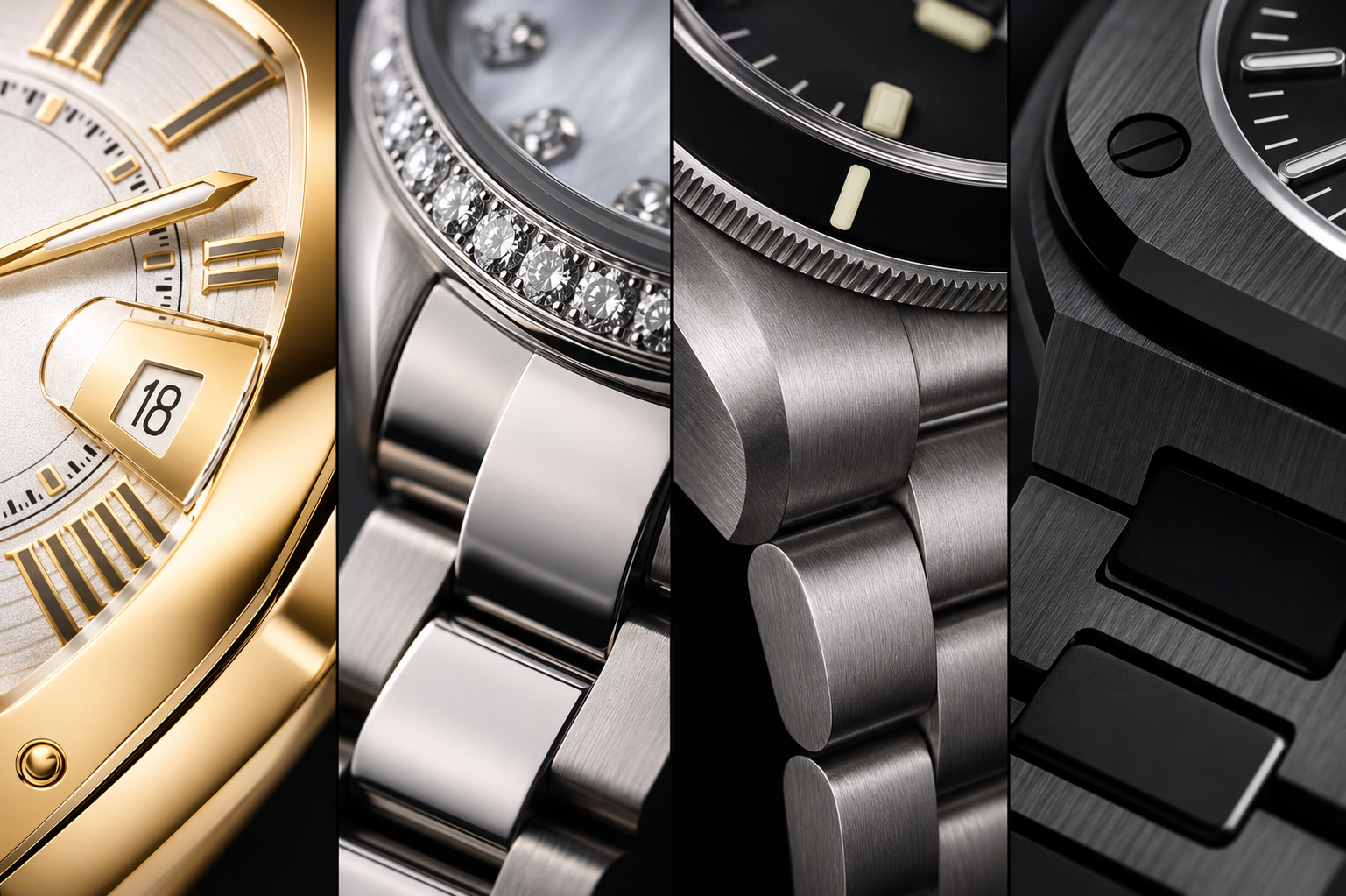
The materials a watch is made from shape how it looks, how much it weighs, how it wears over time, and what it costs. Watch materials fall into a handful of families: stainless steel, titanium, precious metals like gold and platinum, ceramic, and the crystal over the dial. Each one has a job it does best. Steel is the durable all-rounder. Titanium is light and strong. Gold is for prestige. Ceramic resists scratches. This guide walks through every major watch material, what sets it apart, and where it makes sense, so you know exactly what you are holding and paying for.
Stainless Steel: The Everyday Standard
Stainless steel is the most common watch case material, and for good reason. It is strong, resists corrosion and rust, takes a high polish, and holds up to decades of daily wear. Most watches you encounter, from tool watches to everyday luxury pieces, are steel.
Not all steel is equal. The grade most used in watchmaking is 316L, a surgical-grade stainless that resists corrosion well. A smaller number of brands use 904L, a harder, more corrosion-resistant and more expensive grade that takes a slightly brighter polish. For almost all owners, 316L is excellent and the difference is marginal.
Steel’s strengths are durability, value, and versatility. Its trade-offs are weight, since it is heavier than titanium, and the fact that, being relatively common, it carries less prestige than a precious metal. It is the sensible default, and on most watches, the right one.

Titanium: Light and Strong
Titanium is prized for one headline quality: it offers close to the strength of steel at a little over half the weight. For a large sports or dive watch, that weight saving is the difference between a watch you notice all day and one you forget you are wearing.
Beyond being lightweight, titanium is highly corrosion-resistant, hypoallergenic (a good choice for sensitive skin, as it contains no nickel), and more resistant to denting than steel. Its trade-offs: it usually has a darker, greyer tone than the bright shine of steel, it can scratch more easily unless surface-hardened, and it costs more to machine, so titanium watches tend to be priced above their steel equivalents.
Titanium suits anyone who wants a large watch that wears light, or who needs a hypoallergenic metal against the skin.
Gold and Precious Metals: Prestige
Gold is the traditional material of the luxury watch, chosen for warmth, heft, and status rather than practicality.
Pure gold is too soft for a watch, so it is alloyed. The common varieties:
- Yellow gold. The classic, mixed with metals like copper and silver for the familiar warm tone.
- Rose (or pink) gold. A higher copper content gives it a warm, pinkish hue that has become very popular.
- White gold. Alloyed to a silvery color, often rhodium-plated for brightness. It looks similar to steel or platinum but carries the value of gold.
Most gold watches are 18 karat (75% pure gold), the standard that balances richness of color with enough durability to wear.
Beyond gold sits platinum, rarer and denser still, the heaviest and among the most prestigious case materials, with a subtle grey-white tone that does not tarnish. Precious-metal watches share the same trade-offs: they are soft and scratch more easily than steel, they are heavy, and they carry the highest cost.
Ceramic: Scratchproof and Modern
Ceramic has risen fast as a modern watch material, valued above all for being highly scratch-resistant. The ceramic used in watches is an engineered high-tech material (often zirconium oxide), not the brittle pottery the word suggests. It is extremely hard, holds its finish and color for years without fading, is lightweight, and is hypoallergenic.
Its weakness is the flip side of its hardness: ceramic is brittle. It resists scratches better than almost anything, but a hard enough impact against a tile floor can crack or shatter it, where steel would only dent. It is also more expensive to produce and difficult to machine.
Ceramic appears most often on bezels, where its scratch resistance protects the most exposed part of the watch, and increasingly on full cases and bracelets.
The Crystal: Covering the Dial

The crystal is the clear cover over the dial, and it is its own small materials decision. There are three choices.
- Acrylic. A plastic crystal, soft and easy to polish, used on vintage and some entry-level watches.
- Mineral glass. Hardened glass, harder than acrylic, common on mid-range watches.
- Sapphire crystal. Synthetic sapphire, second only to diamond in hardness and the standard on quality watches. It resists almost any everyday scratch.
Sapphire is the choice on most serious watches, because the crystal is the part you look at every day and it keeps the dial clear for decades.
Straps and Bracelets
Material choice extends to how the watch attaches to your wrist. A metal bracelet (usually steel, sometimes titanium, gold, or ceramic) matches the case and feels substantial. A strap can be leather (classic and dressy), rubber (sporty and water-friendly), or fabric such as canvas or NATO webbing (casual and tough). Many owners keep several, since swapping the band changes the character of the watch entirely.
Which Watch Material Is Best?
There is no single best material, only the right one for how you will wear the watch.
- For an everyday watch that takes a beating and holds value: stainless steel.
- For a large watch that wears light, or sensitive skin: titanium.
- For prestige, warmth, and a watch to pass down: gold or platinum.
- For a modern look that shrugs off scratches: ceramic.
- For the clearest, most scratch-resistant dial cover: sapphire crystal, whatever the case is made of.
The best approach is to handle a few in person, since weight and finish are hard to judge from a photo. Our team in Philadelphia can show you steel, titanium, gold, and ceramic side by side so you can feel the differences.
From the Showroom
Across the brands we carry, you can compare the main watch materials directly. Steel sports watches, titanium tool watches, gold dress pieces, and ceramic-bezel models all sit in the same cases, which makes it easy to feel how each wears.
Visit our Philadelphia showroom to compare materials in person, or start at the full Watch Education hub for more on how watches are made and what every part does.
Watch Materials FAQ
What are watches made of?
Most watches are made from stainless steel, titanium, gold or platinum, or ceramic, with a crystal of sapphire, mineral glass, or acrylic over the dial. The band may be metal, leather, rubber, or fabric.
What is the best material for a watch?
It depends on use. Stainless steel is the durable, versatile standard. Titanium is lightest. Gold and platinum are the most prestigious. Ceramic is the most scratch-resistant. Sapphire is the best crystal.
Is titanium or stainless steel better for a watch?
Titanium is lighter, more corrosion-resistant, and hypoallergenic, but costs more and scratches more easily. Stainless steel is heavier but more affordable, takes a brighter polish, and resists dents. Neither is strictly better; it depends on what you value.
What is the most scratch-resistant watch material?
For the case and bezel, ceramic resists scratches best, though it is brittle and can crack on hard impact. For the crystal, sapphire is the most scratch-resistant, second only to diamond.
Why are gold watches so expensive?
Gold is a precious metal with intrinsic value, and a gold watch contains a significant amount of it, usually 18 karat. The material cost, plus the prestige of gold, makes these watches far more expensive than steel.
What grade of steel is used in watches?
Most watches use 316L surgical-grade stainless steel, which resists corrosion well. Some brands use 904L, a harder and more corrosion-resistant grade that costs more and takes a slightly brighter polish.