


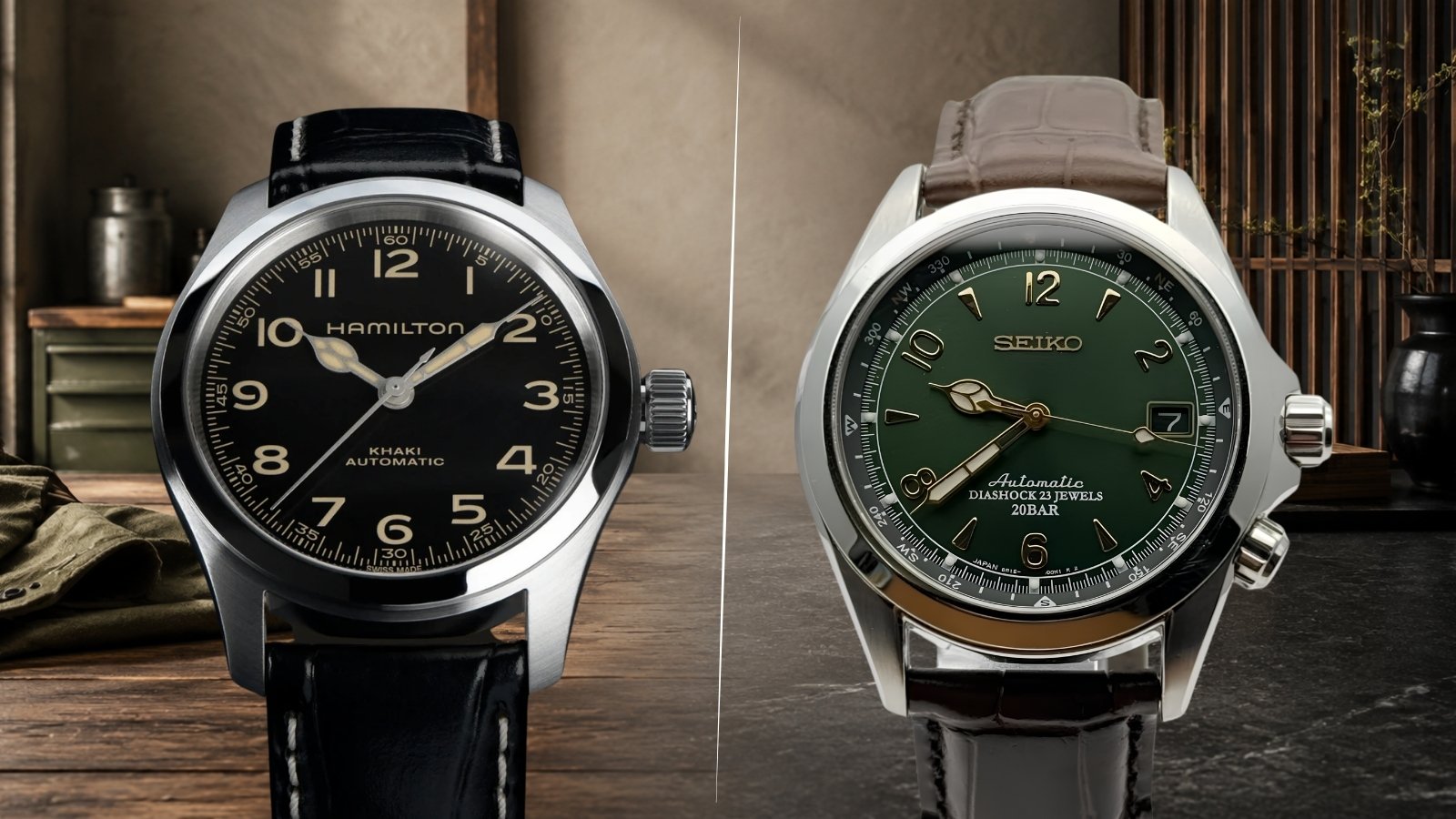
Hamilton vs Seiko is one of the most common comparisons a buyer runs into when shopping for a first serious mechanical watch. Both brands built their reputations on genuine tool watch history rather than flash, and both consistently deliver more watch than their price tags suggest.
This comparison breaks the two brands down by what actually matters when deciding where to spend: price, movements, design, resale value, and which watch suits which buyer.
Price and Positioning
Hamilton’s lineup generally runs from $500 to $1,200 for mechanical references, with the Khaki Field, Jazzmaster, and American Classic collections covering most of that range. Seiko’s mechanical watches span an even wider range, from $200 entry automatics up through $1,000 or more for higher-spec references, with the Seiko 5 line anchoring the brand’s most accessible tier.
That overlap in price is exactly why the two brands get compared so often. Hamilton is Swiss Made, built under Swatch Group ownership, and carries a distinct American heritage story tied to railroads, aviation, and military use. Seiko is Japanese, privately owned, and covers a genuinely enormous range of watches under one roof, from disposable quartz pieces to serious in-house mechanical engineering.

Movements
Hamilton builds its mechanical lineup around ETA and Powermatic 80 movements sourced through Swatch Group’s manufacturing base. The Powermatic 80 delivers an 80-hour power reserve, a genuinely strong spec for the price, and Hamilton markets its mechanical watches specifically around this accessible Swiss engineering story.
Seiko’s movement range is broader than any single brand comparison can fully capture. The entry-level 4R and NH-series automatic calibers power the Seiko 5 and similar lines, while the brand’s higher tiers include COSC-adjacent in-house calibers and, through Grand Seiko, the Spring Drive technology that has no real equivalent at any price. For a pure mechanical comparison at the price points where Hamilton competes, Seiko’s automatics are dependable but simpler than Hamilton’s Powermatic 80 in terms of raw power reserve.
Both brands make a legitimate case here. Hamilton’s strength is a consistent Swiss Made story across its whole catalog. Seiko’s strength is range, with genuinely different tiers of engineering depending on how much you want to spend.

Design and Identity
Hamilton’s identity is built on American railroad, aviation, and military history, and reinforced by decades of film appearances, from 2001: A Space Odyssey to Interstellar to multiple Indiana Jones films. The Hamilton Khaki Field line in particular reads as a direct descendant of watches Hamilton actually built for the U.S. military.
Seiko’s identity is built on decades of genuine horological innovation, including the world’s first quartz watch and some of the most respected dive watches in the industry. The design language covers far more ground than Hamilton’s, spanning field watches, dress pieces, chronographs, and dive watches across dozens of sub-lines.

Seiko’s identity is built on decades of genuine horological innovation, including the world’s first quartz watch and some of the most respected dive watches in the industry. The design language covers far more ground than Hamilton’s, spanning field watches, dress pieces, chronographs, and dive watches across dozens of sub-lines.
The Flagship Matchup: Murph vs Alpinist
The clearest head-to-head sits between the Hamilton Murph and the Seiko Alpinist, since both are the reference most people search for by name when comparing these two brands. Our full look at the Hamilton Khaki Field Murph guide covers the watch made famous by Interstellar in detail.
The Murph runs on Hamilton’s Swiss Made automatic movement inside a Khaki Field case with expedition-style styling drawn directly from the film.
The Alpinist runs Seiko’s in-house automatic caliber and carries its own decades-long history as one of the brand’s most consistently praised field and adventure watches, with a compass-inspired bezel and a lower price than the Murph.
For a buyer choosing between the two, the decision usually comes down to story versus heritage. The Murph carries genuine film and pop-culture appeal alongside Hamilton’s Swiss Made status. The Alpinist carries decades of its own reputation within the Seiko catalog and typically costs less.
Value Retention
Hamilton holds value reasonably well within its price tier, particularly on Khaki Field references and watches tied to a notable film or collaboration. Its Swiss Made status and Swatch Group backing support steady demand on the secondary market.
Seiko’s resale picture varies enormously by reference, since the brand spans such a wide range of production tiers. Entry Seiko 5 references depreciate quickly given how widely available they are new, while discontinued or specialty automatic references can hold up better, and Grand Seiko sits in an entirely different resale conversation from mainline Seiko.
Which Should You Choose?
Choose Hamilton if you want Swiss Made status, a consistent American heritage story, and a more focused catalog that is easier to shop without extensive research.
Choose Seiko if movement variety matters more to you than country of origin, and you want the option to grow into higher tiers of Japanese engineering within a single, familiar brand name.
At Precision Watches, we can help you find the right fit within our lineup. As an Authorized Hamilton Dealer near Philadelphia, we carry the full range of Hamilton watches in the showroom, including the Hamilton Jazzmaster, Hamilton Ventura, and the Khaki Field. Our roundup of Hamilton watches under $1,000 covers the accessible end of the current lineup if you want a starting point.
Hamilton vs Seiko FAQs
Is Hamilton better than Seiko?
Neither is simply better. Hamilton offers Swiss Made manufacturing and a focused, heritage-driven catalog. Seiko offers a wider range of movement tiers and price points within one brand. The right choice depends on whether Swiss Made status or movement variety matters more to you.
Which brand holds value better?
Hamilton holds value reasonably well within its price tier, especially on Khaki Field and film-tied references. Seiko’s resale value varies enormously depending on the specific reference and tier, since the brand spans everything from entry automatics to Grand Seiko.
Is Seiko as good as Hamilton?
Seiko offers genuine engineering depth across a wider range of price points than Hamilton does. Hamilton offers Swiss Made status and a more focused catalog. Both are legitimate choices, and the better fit depends on what you are looking for in ownership.
Is the Hamilton Murph or the Seiko Alpinist the better watch?
Both are excellent. The Murph carries genuine Interstellar film appeal and Hamilton’s Swiss Made status. The Alpinist carries decades of its own reputation within Seiko’s catalog at a lower price. The right pick depends on whether film heritage or long-standing brand reputation matters more to you.
Which is a better first mechanical watch?
Hamilton is a strong first Swiss mechanical watch thanks to its focused catalog and consistent Powermatic 80 movement across most references. Seiko suits a buyer who wants to start at a lower price point with room to grow into higher tiers of the same brand later.


